


🪅 The Unwearoutable World
Updated: Jun 4
Imagine If We Directed All Human Ingenuity
Towards Building The Unwearoutable World
Our Duty - A Manifesto
by Duncan M M Bolam
Good Being | goodbeing.blog | May 2026 |
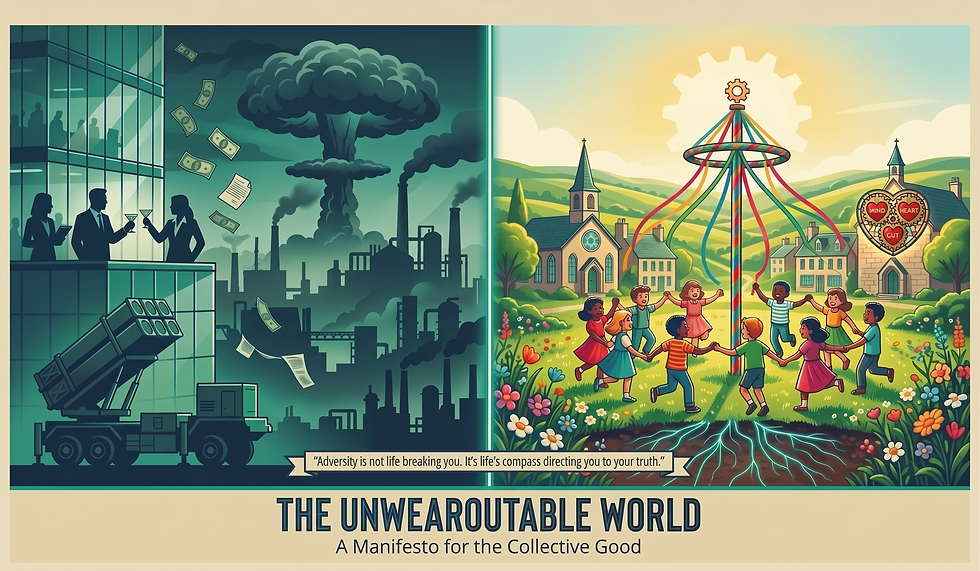
Particularly as the world lurches towards a global conflagration and these apparent End of Days conditions, I find myself, as the 62-year-old father of a 9-year-old son, contemplating with increasing regularity the state of the planet I will bequeath him. At least the responsibility I share in this combined duty that all adults carry for our world’s children, with all our purposes are woven into that reality. *No matter how uncomfortable that duty makes us feel. This essay is born out of the harsh reality that life generally feels like we could be trying a whole lot harder to work towards a world our children would thank us for. A global legacy of the human-collective of which we all deserve to be proud.
There is a vaccination against the world as it has been devised for us by diminutive dynasties founded on wanton ruthlessness, extreme scarcity and insatiable greed. It does not come from a pharmaceutical laboratory, government legislature or a think-tank in Davos. It has always been available to those who cultivate it, in every community that ever organised itself around something far older: activated agency, a meaningful cause, mutual and more durable than the profit motive. Its active ingredients are not synthetic. They are the oldest forces to have carved human life.
Love of place
Love of craft
Love of Self
Love of becoming
Love of effect
Love of belonging
Love of contribution
Love of connection
Love of diversity - in every facet of its incarnation: of peoples, cultures, forms, ways of knowing, ways of making, and the irreducible, sovereign right of every human being to be precisely and distinctly themselves. Vive la difference, not as a charming Gallic shrug, but as a constitutional principle written into the biology of a flourishing world.
… Love of life itself.
Together, these constitute what my Good Being canon calls "Work Aesthetics". Because Homo Sapiens is evolved to fend, love and work are symbiotic, Work Aesthetics is not a theory of labour. It is a description of what human beings become when they are allowed to create, serve and organise common ‘goods’ that matter, for people they know, in places they love, to inherent aptitudes they do well to hone, with skills they have devoted themselves to mastering.
The vaccination of love, administered not as policy but as the daily practice of making, giving, cohering, connecting, stewarding and standing in awe before the exquisiteness that it is to be alive. Seizing this opportunity to be, whilst this fleeting experience called life exists.
This manifesto is about what happens when that vaccination is withheld. And about what becomes possible when we administer it again, at civilisational-scale, without apology and without delay.
It asks what the world could look like if we redirected the full force of human ingenuity away from the economy of manufactured desire, organised scarcity, planned obsolescence, strip-mining our attention and toward the making of a world built, not merely to last, but to be bountiful. A world designed around the Collective Good. A world devoted to human flourishing. A world whose foundational ethic is permanence, reciprocity, sustainability, beauty and shared human dignity.
It is not a utopia. It is a design proposition - as rigorous as its blueprints, as grounded as its historical evidence, as philosophically serious as the human cost of the world it proposes to replace.
It begins with a question about a missile.
Movement One: The Diagnosis of Dysfunction
What the world is and how it got here
Imagine, for a moment, that we directed all human ingenuity towards building the Unwearoutable World.
Not some of it. Not the portion left over after the arms contracts are fulfilled and the quarterly returns are filed. All of it. Every gram of engineering intelligence, every hour of creative labour, every kilogram of rare earth metal, every policy instrument and legal architecture currently in service of the economy of perpetual replacement - redirected, entirely, towards making things that last - for good.
It is worth dwelling on an example of what we are currently pointing that ingenuity at. A Patriot missile costs $4 million to manufacture. Its design life is the length of its arc. From the first drawing board sketch to the moment of detonation, every decision made about its construction - the metallurgy, the guidance system, the propellant chemistry, the environmental cost of the raw materials extracted to build it - was made in the knowledge that it would exist for minutes. That it would be replaced. That another order would follow. That the dividend would flow.
This is not a failure of the system. This is the system working exactly as the dynasties devised it.
The missile is the extractive system's most honest artefact. It makes no pretence of permanence. But the automobile - that symbol of freedom, identity and personal sovereignty that the 20th century sold to every aspiring household on Earth - is something more instructive still. Because the car was designed to fail whilst being sold as an object of enduring value. And the technology to build a genuinely unwearoutable car has existed for longer than most of us have been alive.
In the 1950s, DuPont trademarked Zytel nylon and began decades of research into its automotive applications. Engineers understood that nylon cylinder blocks, polymer composites and non-corrodible body materials could produce vehicles of extraordinary longevity. The unwearoutable automobile was not a fantasy. It was a materials science conclusion. The knowledge existed to build a car you would hand to your grandchildren. It was not built. Not because the engineering failed, but because the business model required the engineering to fail. A car sold once is a car that generates one transaction. A car that rusts, wears out and becomes obsolete on a five-year cycle is a car that generates a lifetime of transactions - and an entire supporting economy of dealership networks, financing, insurance, spare parts, servicing and disposal built on the certainty of its planned deterioration.
Alfred Sloan at General Motors had understood this decades earlier. The annual model change - the deliberate cosmetic and mechanical refresh that made last year's vehicle feel inadequate - was not a response to genuine engineering progress. It was the industrial codification of manufactured desire - "aspirational marketing". Author, Jeremy Rifkin would later trace this same logic through the entire consumer economy. But the automobile is where it originated and was perfected and where its consequences are most visible: in the mountains of crushed metal that mark every decade of the 20th century's productive genius, built on the cunning ploy to market terminal dissatisfaction.
And then came the EV1. In the 1990s, General Motors developed and leased an electric vehicle of genuine capability - quiet, clean, efficient, swift, and by every account of those who drove it, an absolute revelation. In fact, it was so good that by 2003, GM had recalled every single one of them. Drivers who had fallen in love with their cars, who had petitioned and protested and offered to buy them outright, watched their vehicles taken from them and crushed.
Celebrities, engineers, environmentalists and ordinary commuters alike stood at the gates of the salvage yards. It made no difference. The cars were destroyed not because they had failed their drivers. They were destroyed because they threatened to succeed - to succeed so comprehensively that an entire architecture of oil dependency, replacement cycles and fossil fuel revenue would have been placed in jeopardy. The EV1 was not a product recall due to failure. It was the suppression of a sensational success story. The United States oil lobby's intervention in General Motors' electric vehicle programme was the profit-commissioning funnel operating in its most brazenly deviant form: the deliberate destruction of an unwearoutable technology to protect the revenues of an inevitably wearoutable one.
We have always had the ingenuity to build things that last. We have been systematically prevented from doing so by those whose income depends on things needing to be replaced, retired or repaired.
Jeremy Rifkin saw the mechanism clearly. In his book, 'The End of Work', he traced the origin of our insatiable consumer appetite to a single, deliberate act of corporate engineering: General Motors' decision to stratify their automobile ranges by class aspiration. The blue-collar model and the white-collar model. The fancier trim, the brighter chrome, the beefier engine, the niftier radio, the more buttons to twiddle, the greater status symbol of success on the driveway.
From that moment, a bell began tolling in the belly of modern humanity - a hollow, manufactured craving that no purchase could permanently silence, because silence was never the point. The economy required the 'desire bell' of consumptive comparison-making to keep ringing. From now on, it was the Smiths absolute responsibility to keep up with the Joneses, and the Joneses with the Halls. Never again would a consumer be able to settle, satisfied they had enough stuff.
Anne Case & Angus Deaton, in their landmark research into deaths of despair, gave us the mortality data of that bell's long toll. When communities are stripped of meaningful work and left with manufactured desire as their only inheritance, people do not merely suffer. They die. By comparison. By their own hand. By the bottle. By the needle. By overwhelm. The deaths of despair are not a social problem to be managed at the margins. They are the death certificate of a civilisation whose economic architecture has become biologically incompatible with human survival. The antithesis of sustainable living.
bel hooks named the architecture itself: "imperialist, white-supremacist, capitalist patriarchy". Not as polemic. As anatomy. Four interlocking load-bearing pillars whose combined function is to concentrate the power of decision - over what is made, what is valued, what is fought over, what is discarded, and who bears the cost - in the hands of those who will never bear the consequences.
Priced at $4 million per unit, the Patriot missile is not an anomaly within this architecture. It is one of its purest expressions.
Consider what that single object actually represents.
A Patriot missile contains approximately 800 individually engineered components. Its guidance system alone draws on decades of accumulated materials science, precision electronics, propellant chemistry and aerospace engineering. The titanium, the rare earth metals (REMs), the copper wiring, the composite materials that constitute its body - each gram of that payload began as ore extracted from the Earth's crust at incalculable environmental cost: the open-cast mines, the toxic leachate, the destroyed water-tables, the communities bulldozed to access the seams. The carbon cost of its manufacture. The carbon cost of its transport. The carbon cost of its deployment. All of it converted, in the moment of detonation, into heat, shockwave, shrapnel, destruction, rubble and death. Returned to the Earth not as a resource but as a wound.
And then the order is placed for the next one, and the next one, and the next one. It's a hugely profitable industry dealing in death and destruction. And the shareholders love nothing better than a big, fat dividend. As long as the wars their interest is based on are far way.
The United States alone has fired hundreds of Patriot missiles in recent years. A single Patriot battery carries multiple missiles. The global expenditure on missile systems in 2024 ran to tens of billions of dollars annually, across conflicts on multiple continents, with no sign of deceleration as we move deeper into 2026 and the number of active theatres of war continues to climb. Multiply the environmental cost of a single missile by the total number deployed in any one conflict, and the number ceases to be an accounting figure. It becomes a civilisational statement. Apparently, this is what we have decided our Exquisitely Rare Earth is for.
But it is the opportunity cost that should stop us entirely. Every Patriot missile represents 800 components designed and built by some of the most highly trained engineers on the planet. That is the same engineering intelligence that could have built a school constructed to stand for two centuries. A water purification system serving ten thousand people for generations to come. An electrical generation grid that extracts free energy from the atmosphere and never dims...
A Seaman's Hall at the heart of a cooperative community. A housing stock whose grandchildren would inherit the structure without apology. The guidance system alone - the accumulated genius of the people who designed it - could have been the intelligence behind a distributed renewable energy matrix, a materials science breakthrough in sustainable construction, a medical device that would outlast its maker by decades.
We did not lack the ingenuity. We chose what to point it at.
And this is where the embodied insanity of war as a profit system becomes the essay's most urgent argument. War is not, in the 21st century, a failure of diplomacy that the profit-commissioning funnel regrets. It is one of The System's most reliable revenue streams. The reconstruction contracts, the weapons replenishment cycles, the energy market disruptions, the debt instruments issued to finance the conflict - all of it trickles upward. The working and middle classes provide the bodies, the taxes, the grunt, the destroyed infrastructure and the grief. The 0.1% provide the capital and collect the return. In a world of eight billion people and seventeen active armed conflicts as of 2026, that Patriot missile is not an anomaly. It is a rampant business model. And the business model requires the missile to be fired, and the next one to be ordered, and the next conflict to be seeded, and the next generation of engineers to be trained to design a more efficient version of the object whose entire purpose is to cease to exist.
Estimated Profit per Missile (Domestic use USA) = $500,000 – $540,000Estimated Profit per Missile (Export market, global) = $800,000 – $1.2M+
(Whereas, by shuddering contrast of economic principles and political ideology, the now infamous Iranian Shahed-136 drone comes in at between $7,000 - price per unit. Because it's performance is not measured by profitability. It is measured purely on the basis of efficacy, producability, and principles.)
This is not a civilisation that has failed to find peace. It is a civilisational model whose dominant economic architecture has a structural incentive to prevent it.
Yanis Varoufakis extends that anatomy into our present moment with a precision that should stop us cold in our tracks. In 'Technofeudalism', he argues that we have not reformed feudalism, nor escaped it. We have reinvented it - invisibly, algorithmically, at planetary scale - through what he calls cloud capital and the rents it silently extracts from every human being who relies upon a digital presence simply to exist in the modern economy. (I am both feeding it, and entrapped by the phenomena now as I type).
Amazon does not merely sell you things. It owns the territory on which all contemporary commerce takes place, and it charges rent for that ground - not openly, not as a visible toll, but structurally, inescapably, as the price of access to the market itself.
Category | Market Share Percentage |
Total Global Retail | ~2.2% |
Global E-commerce | ~14% |
U.S. E-commerce | 40.4% |
Cloud Computing (AWS) | ~31% (Global Infrastructure) |
The lord's castle has been replaced by the server farm. The visible violence of feudal enforcement has been replaced by the invisible compulsion of having few or no other routes to market. And crucially, unlike the serf who could at least see the castle and know the name of their lord, the contemporary digital serf believes themselves to be a free agent in an open marketplace. That is the upgrade. That is the genius of it. Exploitation rendered indistinguishable from participation. A cunning monopoly. A closed loop. A golden goose by anyone's definition.
Gary Stevenson provides the contemporary financial forensics: the asset transfer from the working and middle classes to the 0.1% is not a side effect of the rules. It is what the rules 'they' lobbied for and wrote into law were written to produce. The legal, monetary and ownership architecture of the world we inhabit is not a neutral framework within which economic activity happens to produce inequality as an unfortunate side effect. It is an active extraction mechanism - a profit-commissioning funnel - whose design ensures that value flows upward regardless of where it is generated, and whose newest layer operates not on visible land but on invisible cloud.
And then there is Klaus Schwab. The founder of the World Economic Forum, convener of Davos, architect of what he calls the Great Reset, who in 2016 offered the world a vision of 2030 with the following promise: "you will own nothing, and you will be happy". It was presented as (camouflaged as) liberation. As the frictionless future of abundant access, where possessions are replaced by subscriptions, ownership by platform membership, permanence by the perpetual convenience of on-demand. What it described, with the serene confidence of a man for whom ownership has never been in question, was the logical destination of every mechanism we have traced in these pages. If you own nothing, somebody owns everything. If access is mediated by platforms, somebody owns the platforms. If nothing is permanent, the rent never stops. The cabal has grown confident enough to dispense with the disguise. The castle is no longer hidden. They are simply telling us, with considerable politeness, that we will never live in it.
Every missile, every privatised utility, every cloud rent, every death of despair is not an anomaly in this system.
It is a dividend.
Interpretive Humanics - the Good Being discipline that studies how human beings derive meaning, direction and vocation through the interpretation of lived experience - teaches us to read what life presents not as a verdict but as a signal. Applied to the civilisational scale of the crises we are in, it asks: what is the extractive system telling us about the Question it was built to answer?
The honest answer is that it answered its Question extraordinarily well. The Wearoutable World was built to answer the 19th century’s most urgent demand: how do we produce enough for enough people fast enough? And it did. In one century it lifted more people out of absolute poverty than in all preceding human history combined. It produced antibiotics, mass literacy, clean water infrastructure, the eradication of diseases that had killed children for millennia. We should hold that truth steadily before we indict the system that produced it.
But Interpretive Humanics teaches us something further. When the same task, obstacle or adversity presents itself repeatedly, it is no longer instruction. It is misalignment made visible. The extractive economy has been answering the same Question - how do we produce more - long after the world moved on to a different Question entirely. It has no mechanism for reading the signals that its own outputs generate. It registers the deaths of despair not as feedback about the fitness of The System, but as an acceptable externality of growth. It registers the thermodynamic depletion of the planet’s living systems not as a collapse signal but as a cost to be managed. It cannot interpret what it produces because it was never designed to interpret or consider it. It was designed to extract. Tomorrow doesn't matter because it never arrives. Why should these people care if they didn't have a conscience capable of caring in the first place?
This is the civilisational misalignment that Interpretive Humanics names. Not a failure of ambition or intelligence. A failure of the interpretive faculty itself. A species that evolved - as the Constitution of Humanity makes clear - precisely to read its environment and respond through truthful action, operating a system designed to suppress that capacity in favour of a single, endlessly repeated, increasingly destructive output.
Surely, recognising the consumptive naïveté of the 19th and 20th Centuries' Questions, the 21st century’s Question is not how do we produce enough. It is how do we sustain what we have produced without consuming what we need to survive - and how do we organise human civilisation so that every person’s vocational potential is expressed rather than wasted, contributing to the whole rather than leaking away as the spiritual landfill of misalignment.
The Unwearoutable World is the civilisation built around that Question. Its architecture is not a repudiation of what came before. It is what Interpretive Humanics would have us build when we finally learn to read the signals that the existing system has been generating, at accelerating cost, for two hundred years. It is time to own the fact that the "Growth Economy" is the absolute epitome of what it is to live unsustainably.
But to understand why this system persists - why it is so totalising, so apparently immune to challenge, so capable of making its own outputs feel like natural law -- we need to go further back than Rifkin, further back than Varoufakis, further back even than the first enclosure of the commons. We need to find the myth.
There is a story we have been telling ourselves for a century and a half that has brought us to this moment. It is dressed as science. It carries the borrowed authority of Darwin's name. But it is not science. It is myth - the most consequential and the most destructive myth the modern world has produced.
Herbert Spencer watched Darwin describe the mechanism by which organisms adapt under competitive pressure and heard something Darwin never said. He heard permission. Permission to take the observation that some organisms survive and others do not and convert it into the moral prescription that the strong deserve to accumulate and the meek and the weak deserve their fate. "Survival of the fittest" was always Spencer's phrase, never Darwin's. Darwin described a process. Spencer declared a hierarchy. And in that act of deliberate mistranslation, he handed the mills and the empire and the enclosures and every subsequent iteration of the profit-commissioning funnel the one thing they most required to justify it: a natural law.
What followed was not the inevitable unfolding of human nature. It was the systematic administration of an immunosuppressant. A philosophy so totalising, so woven into the fabric of economic life, political language and individual self-understanding, that even its victims internalised it. The redundant worker who blames their own inadequacy. The community that accepts its abandonment as the market's verdict on its fitness. The child in the cul-de-sac estate who never questions why the street is a road and the neighbours are strangers, because this is simply how the world is, and the world is simply nature, and nature is simply the survival of the fittest. Spencer's myth did not merely justify the extractive system. It made the extractive system feel just like the Law of Gravity. Inevitable. Impersonal. Natural. Dispassionate.
But David Loye, in his meticulous recovery of Darwin's lost theory, shows us what Spencer amputated and discarded. Darwin believed that moral sense and the power of sympathy were the dominant forces in human development, far outweighing competitive selection. The cooperative impulse was not Darwin's sentimental afterthought. It was his central claim about what distinguishes the human animal from the merely biological struggle for survival. Spencer gave us half a Darwin and called it natural law. He gave us the tooth and the claw and suppressed the hand extended in recognition, the hall built in common interests, the street named after the communal society its builders were consciously constructing.
So let us perform the act of intellectual restoration that this moment requires. Let us take Spencer's poisoned maxim and turn it, with precision and without apology, into its antonym.
Mutual flourishing by living as one loving being.
This is not a slogan. It is not a political programme. It is a description of what human beings actually are when the immunosuppressant is withdrawn and our cooperative immune response is allowed to mount. It is what the Fishertown cooperators in Nairn, where I live in The Highlands of Scotland, were enacting when they built the Seaman's Hall. It is what the Miners' Welfare Halls in my native North East of England expressed before Thatcher levelled them. It is what Society Street was named for. It is what every child playing in a street - a real street, a commons, a shared ground, a common good - instinctively knows before the architecture of isolation teaches them otherwise.
Mutual flourishing by living as one loving being is also, as it happens, a more accurate account of Darwinian biology than Spencer's version. A monoculture does not flourish. It produces maximum yield for minimum seasons and then collapses, because it has eliminated the diversity and redundancy that authentic resilience requires. The mycorrhizal network beneath a forest floor is not a competition. It is a mutual aid society of staggering complexity and beauty, in which trees feed each other through fungal threads, in which the strong support the weak because the forest's survival depends on the health of every part. Spencer told us we were the fittest, fighting to survive. The forest tells us we are one loving, interconnected, interwoven entity, called to flourish, and thrive, and sustain ourselves together.
And note what mutual flourishing requires that survival of the fittest specifically destroys: difference. The forest's resilience is the very diversity of its nature. The coral reef's beauty is its variety. A civilisation that homogenises - that produces the same film in every multiplex, the same coffee on every high street, the same house on every edge-of-town development, the same algorithm-optimised content in every phone feed - is not merely aesthetically impoverished. It is biologically fragile. It has traded the immune depth of genuine variety for the scalable sameness that the profit-commissioning funnel requires. You cannot mass-produce the irreplaceable. But the irreplaceable is precisely what a flourishing world is made of.
Movement Two: The Evidence at Human Scale
What was lost, and how:
All of this happened somewhere. The myth was not merely a philosophical position. It was administered, brick by brick and policy by policy, into the lived fabric of actual communities, actual streets, actual halls built by actual hands. Let me show you where.
I want to take you somewhere specific. To Nairn, on the Moray Firth in the Highlands of Scotland, where I live. It is a town with two histories running through it like parallel veins.
One is the history of Fishertown. Before the Victorian era made Nairn famous as a wellbeing destination - before Dr John Grigor's civic vision transformed it into the Brighton of the North, where the ailing and the weary came to take the waters and the bathing machines lined a shore prescribed as medicine - there was a fishing community that had organised itself, quietly and without instruction, around something older and more durable than any government programme.
The people of Fishertown built their Seaman's Hall. They built schools and chapels, art schools and theatres, libraries and the shared infrastructure of a life lived in communion with one another. They cooperated because cooperation was not an ideology to them. It was the only rational response to shared conditions. And they were not a uniform community. Each fisherman brought his own boat, his own knowledge of the water, his own relationship to the sea and the season and the particular stretch of Moray Firth he knew best. The cooperative did not erase such distinction. It celebrated it. Each person brought what they specifically and irreducibly were. The whole was richer for the particularity of every part. The collective whole was a celebration of the very diversity that defined it. Their unitedness their strength.
And somewhere in the naming of their streets, they left us a signal so plain that we have almost stopped seeing it. They called one of them Society Street. Not Commerce Street. Not Enterprise Street. Society Street. Because what they were consciously building, brick by brick and net by net, was a society. The Collective Good made visible in stone and timber and mutual obligation.
That is the Unwearoutable World. Not imagined. Already built. Already lived.
Now look at the other history. The same town, the same streets, today. When the roads fall into disrepair, we do not gather to mend them. We complain to a council. When the public facilities are neglected, we do not organise. We post our dissatisfaction into the void of a bureaucratic inbox and wait, without much expectation, for a response that may or may not come. The civic muscle that gave birth to Society Street has not merely weakened. It has been systematically denervated. The privatisation of local government did not simply change who owned the services. It severed the living connection between a community and its own infrastructure. It taught several generations that maintenance is someone else's responsibility. That pride in shared space is someone else's job. That the 'we' of Society Street is now the 'they' of the council.
This is not a story about administrative failure. It is a story about what happens when the Collective Good is outsourced, and administrated by a body that possesses zero stake in it.
We should be careful not to romanticise the people who built what we are now admiring. The Victorians were, in many respects, morally catastrophic. They built empire on subjugation and exported their confidence across continents with a psychopathic disregard for the peoples and cultures they exploited. With Spencer's maxim as their license, their treatment of their own poor was frequently barbaric. We should hold none of that lightly.
And yet. What they built still stands.
The Fishertown housing stock will shelter families for another century if we let it. The civic buildings - the halls, the libraries, the schools, the chapels - carry the weight of their original intention without apology. Stone laid with the assumption that it would outlast its layer. Timber jointed with the understanding that someone not yet born would one day depend on its integrity for shelter and security. There was, embedded in Victorian construction at its most civic and cooperative, an ethic of permanence that is yet to be fully colonised by the profit motive.
Now look at what we are building on the edge of Nairn today. On the edge of every town in Britain today. Estates of houses assembled from materials chosen not for their durability but for their margins to distant investors. Walls that will not breathe. Roofs that will not weather. Insulation that traps damp and breeds the kind of slow structural failure that will become somebody else's problem in fifteen years, long after the developer has dissolved the company and banked the return. These are not Intergenerational homes built with the assumption that a grandchild will inherit them. They are units built with the assumption that a mortgage will be arranged, a profit taken, and a liability transferred.
But the deepest loss is not structural. It is spatial. It is social. The new estate has no street. It has roads - infrastructure designed for passing through, not for being in. It has double garages and close-boarded fencing, and the studied privacy of people who have been architecturally instructed not to get to know their neighbours. The shared space that once made civic life possible at its most granular and most human has been designed out. Not accidentally. The street generates no margin.
Our children no longer play in the street. Not because childhood has changed. Because the street - as commons, as shared ground, as the most basic unit of civic life - has been replaced by a road. And a road is not a place. It is a detour. You cannot build Society Street on a social cul-de-sac. You cannot build the Collective Good on a foundation of thirty-year structural warranties and rapidly dissolved development companies. With vanished liabilities and accountability.
The Welsh sociologist Huw Beynon, who grew up in the coal and steel community of Ebbw Vale and spent fifty years documenting what was done to communities like it, called the destruction of Britain's Miners' Welfare Halls - those self-built social and intellectual centres of cooperative working life - an act of ruthless disregard for the values of care and association. He was right. Beynon and his co-author Ray Hudson are unambiguous on the central point: the deindustrialisation that destroyed these communities was not an economic inevitability. It was a deliberate political choice - the crushing of organised labour's potential power, standing as it did in the way of a globalised and marketised future. Those communities were not casualties of progress. They were collateral damage of a strategy. The Seaman's Hall and the Miners' Welfare Hall were not different buildings. They were the same building, in different towns, expressing the same cooperative conviction that what a community makes together, shares in together and makes to last is the truest declaration of what it believes its members to be worth. This is a dividend that buys more than money ever could – mutuality.
We have still not reckoned with what we lost.
I am not a religious man in any institutional sense. Dogma of every variety strikes me as the enemy of the awe it purports to serve. But I am, with increasing conviction as I grow older, a man who cannot look at what Lovelock called Gaia -- this extraordinary, logic-defying, apparently infinitely improbable, self-regulating tapestry of life that clings to the surface of a beating Earth in a strip barely 20 kilometres deep, clinging precariously to a blue orb - diameter 12,756 kilometres, spinning at 1,670 kilometres per hour – unique in a galaxy containing ~4 billion stars - and reach for the word accident. Exquisite barely covers it. Miraculous undersells it. The mystifying interface of life and Earth and Spirit and Soul, the mindboggling complexity of an organism that produces not merely survival but consciousness, beauty, love, and the capacity to be entranced by a sunset - this exceeds what chance alone can account for or explain.
I will not claim the Evangelical's certainty. I have neither earned it nor do I trust it, even now. And yet, I find myself, at this stage of my life, genuinely served by the hypothesis of a Super Being. Not the bearded patriarch of institutional religion, not the interventionist deity who rewards the faithful and punishes the doubter, but something far older and stranger and more exquisite than any doctrinal explanation has managed to contain: an originating intelligence of such unfathomable creativity that its signature is written into every mycorrhizal network (wood-wide-web) beneath every forest floor, every migration route of every Arctic tern, every salmon's returning to their river of origin to spawn, every mother's instinctual ability to pick out her baby's cry from a thousand others, every spiral galaxy visible from the Highland darkness above Nairn on a clear winter night.
What I am certain of - the one conviction I hold without equivocation - is this: we are the Apex Species not by right of conquest but by weight of responsibility. We did not earn this planet. We were lent it. And the name for what we were given it to do is not ownership, not exploitation, not the extraction of every resource the profit-commissioning funnel can locate and monetise. The name for what we were given it to do is stewardship. Curation. The loving, careful, generationally responsible tending of a Creation so improbably beautiful that the only adequate response to it is the one the Fishertown cooperators enacted without theorising: to make what we make as well as we possibly can, to give it freely to those who will come after us, and to leave the place more alive and intact than we found it.
To do otherwise - to desecrate the commons, to dissolve the development company and bank the return, to design the missile and collect the dividend and tell the dispossessed, dismembered and disenfranchised that they will own nothing and should be happy -- is not merely political failure or economic injustice. It is a betrayal of the role we were improbably, magnificently, and, I believe, deliberately given. It is a desecration. And desecrations, however long they persist, do not withstand scrutiny for the Good Being.
Movement Three: The Hinge
What if we built differently?
Not as a reform of what exists. Not as a more humane version of the profit-commissioning funnel. Not as better regulation of the cloud rent or a fairer distribution within the existing architecture of extraction. A replacement. Designed. Evidenced. Philosophically grounded. Morally serious. Built from the inside out.
The vaccination of love has always been available. The Fishertown cooperators were vaccinated. The builders of the Seaman's Hall were vaccinated. The people of Society Street were vaccinated. They were not enacting an ideology. They were living the immune response that the species already knows how to mount, whenever the immunosuppressant is withdrawn and the conditions for mutual flourishing are allowed to exist.
The Unwearoutable World does not require human nature to change. It requires the architecture of human culture itself to change -- so that love of place, love of craft, love of belonging, love of the irreducible particularity of every human being becomes the rational response to shared conditions, as it was in Fishertown, as it always has been wherever the profit-commissioning funnel has not yet reached.
We are not building something new. We are remembering something ancient. And we are building it this time with blueprints.
We are living through the terminal phase of an architecture, not its zenith. The signals are unmistakable to anyone willing to read them. Seventeen active armed conflicts. Ecological systems approaching irreversible tipping points. Democratic institutions hollowed out by the capture of information infrastructure. A dozen privately held technological empires - mostly American, mostly controlled by individuals whose combined wealth exceeds the GDP of most nations - now owning the ground on which public discourse, commerce, education and social connection take place. This is not the world at the height of its powers. This is the world consuming the conditions of its own survival.
We should be precise about what this moment is and is not. It is not apocalypticism - the seductive, paralysing narrative that collapse is total, irreversible and beyond human agency, that the barbarians are at the gate and the lights are going out. Apocalypticism is itself a product of the Wearoutable World's logic: it is Spencer's immunosuppressant administered in its most potent form, the final argument against cooperative action, the counsel of despair that tells the individual their effort is meaningless against the scale of what is failing. The antithetical state to apocalypticism is not naive optimism. It is the civilisational application of the Law of Adversity: the reading of these signals not as a verdict but as navigation. The End of Rome is not the end of humanity. It is the friction that names the direction. The Wearoutable World's terminal phase is not a catastrophe to be survived. It is the most powerful feedback signal in human history, pointing with unmistakable force toward a different architecture entirely.
The transition we are describing - Post Industrial, Post Growth, potentially Post Money - is not a regression. Every time a human civilisation has moved beyond a dominant economic arrangement, the advocates of that arrangement have predicted barbarism. The feudal lords predicted that the end of serfdom would mean starvation. The mill owners predicted that the end of child labour would mean economic collapse. The fossil fuel lobby predicts that the end of carbon dependency will mean civilisational darkness. They are wrong in each case for the same reason: they mistake the scaffolding for the building. The arrangement that served one era of human need is not the same thing as human need itself.
Post-industrial does not mean primitive. It means the reorientation of productive intelligence away from the manufacture of disposable objects and toward the making of durable ones - buildings that outlast their builders, communities that outlast their founders, knowledge systems that deepen rather than fragment across generations. Post Growth does not mean stagnant. It means the measurement of flourishing by something other than the volume of transactions - by the health of ecosystems, the depth of vocational alignment, the richness of civic life, the longevity of what is made. Post Money does not mean the end of value. It means the end of value being measured exclusively by a metric designed to concentrate it upward, and the beginning of value being understood as what Unconditional Reciprocity has always understood it to be: the invisible symmetry by which life sustains life, circulating through communities rather than extracting from them.
What does this transition look like in motion? Not like a revolution. Not like a single decisive political event that changes everything simultaneously. It looks like what it has always looked like when a civilisation finds a new architecture: patchy, uneven, volatile, beginning at the edges and the margins rather than the centres of power, visible first in communities that have the least to lose from abandoning the existing system and the most to gain from building something more durable. It looks like the cooperative that forms without asking permission. The circular economy enterprise that makes things built to last and finds its market among people who have grown exhausted by things that fall apart. The community energy grid that decouples a neighbourhood from the fossil fuel infrastructure. The local food network that rebuilds the knowledge and the relationship that industrial agriculture spent a century destroying. None of these are the Unwearoutable World in its fullness. All of them are its cellular expression -- the immune response beginning in single activated cells before it becomes the systemic recovery of the whole.
The specific obstacle to this transition is not ignorance. It is not even inertia. It is the concentrated power of entities that have a structural incentive to prevent it. The platform oligarchs who own the cloud have no interest in a Post-Money world because their cloud rents require money. The weapons manufacturers who profit from conflict have no interest in a Post-Industrial peace dividend. The fossil fuel interests that fund the democratic capture of regulatory systems have no interest in the renewable energy transition that a Post-Growth civilisation requires. These are not villains in a morality tale. They are rational actors within a system whose logic demands that they behave exactly as they do. The problem is not their character. It is the architecture that makes their behaviour the rational response to shared conditions - precisely the same insight that Fishertown's cooperators embodied in reverse, when they built a hall and named a street after the society that made mutual flourishing the rational response instead.
This is why the Unwearoutable World cannot be commissioned by the existing system. It cannot be petitioned into existence or regulated into being by the institutions that the existing system controls. It is built, as it has always been built, from the ground up. From the community that decides its roads matter enough to mend them without waiting for the council. From the cooperative that builds its hall without a grant. From the individual who finds, through the Law of Adversity, that the life the profit-commissioning funnel designed for them was never theirs - and builds differently from that moment forward. The transition from the Wearoutable World to the Unwearoutable one is not a political event. It is a civilisational immune response. And as with every immune response, it begins not with an institution but with a cell. A single, appropriately activated human being, living as one loving being, building what needs to be built.
Society Street was not commissioned. It was loved into being by a community who cared enough to cooperate.
That is how the transition begins. That is how it has always begun.
Movement Four: The Vision - The Unwearoutable World
So, imagine we built differently.
Not gradually. Not incrementally, nudging the existing architecture toward slightly less extractive behaviour whilst leaving its foundations intact. Differently. From the ground up. With the full force of the human ingenuity that currently designs Patriot missiles and cloud rent algorithms and planned obsolescence cycles redirected, entirely and without apology, toward a single question: what does the Collective Good actually require?
Jacque Fresco spent most of his 101 remarkable years doing what the rest of us have mostly only argued about. He designed the alternative way. Not as metaphor, not as aspiration, but as blueprint. Working from a 22-acre research centre in Venus, Florida, which he and his partner, Roxanne Meadows, built The Venus Project with their own hands as a working model of their ideas, Fresco drew circular cities configured around human need and resource abundance rather than profit and manufactured scarcity. Cities in which, as he put it, the whole city is a park -- not a park as an amenity added to a development after the margins have been calculated, but as the fundamental condition of the built environment itself. Cities whose infrastructure was designed as an evolving, integrated organism rather than a static structure. Cities powered by geothermal, solar, wind and wave energy, not because these were ideologically preferable but because they were simply the most intelligent use of what the Earth actually provides in abundance.
And crucially: each city is unique. Each one shaped by the specific geography, culture, ecology and community it served. Fresco understood what Spencer suppressed: that diversity is not a complication to be managed but the very source of a living system's intelligence and resilience. The Unwearoutable World is not a world of identical circular cities and standardised reciprocity. It is a world in which the removal of manufactured scarcity finally liberates human beings to be fully, distinctly, gloriously themselves -- individually and collectively simultaneously.
Fresco called the economic model underlying all of this a resource-based economy. A system in which all goods and services are available to every human being without money, credit, barter or any architecture of debt and servitude. In which the Earth's resources are understood as the common heritage of all the Earth’s people - not the extractable property of the few whose ownership of the ground, the cloud and the castle Varoufakis and Stevenson have so forensically documented. Fresco's reasoning was disarmingly simple: the Earth is genuinely abundant. Scarcity is not a natural condition. It is an engineered one, maintained by the monetary system precisely because scarcity is the mechanism through which the profit-commissioning funnel operates. Remove the engineering of scarcity, and you remove the conditions that generate the poverty, the crime, the war and the despair that the existing system then requires armies, prisons and Patriot missiles to manage.
The United Nations awarded Fresco its prize for City Design and Community in 2016, less than a year before his death at the age of 101. He never built a circular city at scale. Not because the design was inadequate. Because the system that controlled access to the resources needed to build it was precisely the system his design was intended to replace. The invisibility of Fresco’s legacy is not accidental. It is structural. You cannot commission the Unwearoutable World from within the architecture of the Wearoutable one and expect the funding to arrive.
But his blueprints exist. And they point, with a precision that no amount of reformist tinkering can match, toward what the Unwearoutable World looks like when it is actually built rather than merely imagined.
There is, however, something the Venus Project blueprints do not fully address. They tell us what the city looks like. They do not tell us what the human being inside that city is for. They design the outer architecture with extraordinary rigour and vision. But the inner architecture -- the question of how a person finds their way to their own truth within a world that no longer organises their life around manufactured desire and the discipline of financial necessity -- that remains, in Fresco's work, largely unaddressed. This is where the Good Being canon enters the blueprint.
The Meaning of Life-Engine
The Meaning of Life-Engine - Gut, Heart and Mind orbiting Life-Force - is the interior architecture that the Unwearoutable World requires its citizens to inhabit. But to understand how a human being finds their way to that interior architecture, we need to name the navigational system that makes the journey possible.
I call it the Law of Adversity.
It is the central thesis of my forthcoming book, The Answer, and it proposes something that runs directly counter to a quarter century of Law-of-Attraction culture: that adversity is not life breaking us. It is life directing us. Not cosmic punishment. Not personal failure. Not the evidence that we thought the wrong thoughts or failed to manifest the right reality. Adversity is information. It is the most honest feedback system available to a human being -- the friction that reveals misalignment, the obstacle that names the direction, the loss that strips away what was never truly ours and leaves visible what always was.
The Law of Adversity does not ask us to suffer more gracefully. It asks us to read more intelligently. To stop treating the hardest moments of our lives as verdicts and start treating them as signals.
Applied at civilisational scale - which is what this manifesto does - the Law of Adversity becomes something larger still. The deaths of despair that Case and Deaton measured are not merely a public health crisis. They are in adversity at the scale of a civilisation that has lost the capacity to read its own signals. The Wearoutable World is a world in organised flight from the feedback that would require it to change. The Unwearoutable World is the civilisation that has learned, finally, to interpret what life has been trying to tell it all along.
In a world no longer organised around consumption and manufactured aspiration, the question that every human being faces is not what can I afford or what do I want next but who am I, what am I for, and what does my particular and irreplaceable contribution to the Collective Good look like? These are not easy questions. They are the questions that adversity has been trying to ask us all along -- directing us away from the life that the profit-commissioning funnel designed for us and toward the life that our own Gut, Heart and Mind have always known was ours.
Work Aesthetics:
Work Aesthetics - labour as love made visible, craft as contribution, vocation as dignity enacted - is not a luxury available only to those fortunate enough to find meaningful work within the existing economy. It is the founding ethic of the Unwearoutable World's entire productive life. In a world that makes things once and makes them well, in which the Patriot missile's $4 million of engineering intelligence is redirected toward building a school that will stand for two centuries, or a house whose grandchildren will inherit its structure without apology, or a Seaman's Hall at the heart of a fishing community that organises itself around mutual obligation and shared pride - in that world, Work Aesthetics is not an aspiration. It is the minimum standard. The baseline moral contract between maker and receiver: you deserve to live with beauty. I will make it accordingly.
Work Aesthetics is the vaccination administered. It is what the active ingredients of love look like when they leave the interior and become visible in the world:
Love of place.
Love of craft.
Love of Self.
Love of becoming.
Love of effect.
Love of belonging.
Love of contribution.
Love of connection.
Love of diversity - the sovereign, non-negotiable, biologically necessary right of every human being to be irreducibly and distinctly themselves.
Love of life itself.
This is what the Seaman's Hall was built from. This is what Society Street was named for. This is what the mycorrhizal network beneath every forest floor has been enacting without theorising for four hundred million years. This is the antonym of survival of the fittest, made real in stone and timber and salt air and the care of hands that knew their work would outlast them.
Unconditional Reciprocity:
Unconditional Reciprocity is the economic model that replaces the profit-commissioning funnel at the level of daily human exchange. Not charity. Not the gift economy as a naive alternative to money. Reciprocity as physics - the invisible symmetry by which life sustains life, the circulatory system of a civil society that has remembered what Nairn's Fishertown knew and what the Seaman's Hall embodied: that what a community makes together and gives freely is the most honest declaration of what it believes its members to be worth.
The Constitution of Humanity:
The Constitution of Humanity - dignity, reciprocity, responsibility and care as the moral floor and ceiling of all human exchange - is the legal and civic architecture that replaces the profit-commissioning funnel at the level of institutional design. Every law, every ownership model, every monetary instrument, every planning regulation that currently serves the extraction of value upward toward the 0.1% is replaced, in the Unwearoutable World, by instruments designed to answer a single prior question: does this serve the Collective Good? Not the shareholder. Not the quarterly return. Not the cloud rent. The Collective Good. The common heritage of all the Earth's people, as Fresco named it. The society that Society Street was built to express. The Creation that, as the Apex Species, we were given not to own but to steward.
The Closing Declaration
This is not utopianism. Utopianism imagines a perfect world and offers no account of how to get there. The Unwearoutable World is a design proposition - as rigorous and as serious as Fresco's circular city blueprints, as grounded as Nairn's Fishertown cooperative culture, as forensically evidenced as Beynon's documentation of what was deliberately destroyed and why. It does not require a change in human nature. It requires human architecture to change - the legal, monetary, spatial and civic structures within which human nature operates.
Human beings built Society Street. Human beings built the Seaman’s Hall. Human beings organised a fishing community around mutual obligation and called a street after the society they were consciously constructing. They did not do this because they were morally superior to us. They did it because the architecture of their world made mutual flourishing the rational and natural response to shared conditions. They were living as one loving being before anyone had named it.
We built a different architecture. One that makes isolation the rational response. That makes the six-foot fence panel the sensible choice. That makes the cul-de-sac the default unit of community. That makes the council inbox the substitute for civic agency. We built it deliberately, in service of a system whose continuation required our atomisation, our manufactured desire, our passive consumption and our political resignation. We administered Spencer’s immunosuppressant so thoroughly, for so long, that we forgot we were ever vaccinated.
We can build differently. We have always been able to build differently.
The Fishertown cooperative knew it. Fresco blueprinted it. Beynon documented what was destroyed to prevent it. Case and Deaton measured the cost of preventing it in bodies. bel hooks named the ideology that authorised the prevention. Varoufakis showed us the newest and most total form that prevention has taken. And Schwab told us, with the serene confidence of a man who has never needed to own anything because he already owns everything, where the prevention is headed.
The Unwearoutable World is the answer to that destination. Not a protest against it. Not a reform of it. A replacement for it - designed, evidenced, philosophically grounded and morally serious. Built from the inside out: from the Meaning of Life-Engine outward through Work Aesthetics and Unconditional Reciprocity and the Constitution of Humanity, to the circular city and the common heritage and the street where children play because the street was designed to be lived in rather than passed through.
Spencer told us to compete. Gaia has always told us to flourish together.
Imagine we directed all human ingenuity toward building that world.
We have everything we need. We have always had everything we need.
What we have lacked, until now, is the willingness to name what stands in the way -- and the architecture to replace it with.
This is the blueprint.
My upcoming launch of The Answer book heralds the beginning of this shift.
Intellectual Lineage
This manifesto draws on the following thinkers and works, cited as critical witnesses, diagnosticians or architects of the vision set out above.
Jeremy Rifkin, The End of Work (1995). Anne Case and Angus Deaton, Deaths of Despair and the Future of Capitalism (2020). bel hooks, on imperialist white-supremacist capitalist patriarchy, across her body of work. Yanis Varoufakis, Technofeudalism: What Killed Capitalism (2023). Gary Stevenson, on asset transfer and wealth concentration. Klaus Schwab, The Great Reset (2020) and associated World Economic Forum materials, cited as the counter-position this manifesto addresses. Jacque Fresco and Roxanne Meadows, The Venus Project: The Redesign of Culture (1995) and Designing the Future (2007). Huw Beynon and Ray Hudson, The Shadow of the Mine: Coal and the End of Industrial Britain (2021). David Loye, Darwin's Lost Theory (2004). James Lovelock, Gaia: A New Look at Life on Earth (1979). DuPont Corporation, Zytel nylon research programme (1950s onwards). John Ruskin and William Morris, on the moral dimension of craft and labour. Carlo Petrini and the Slow Movement, on presence over pace. Herbert Spencer, Social Statics (1851), cited as the counter-position whose antonym this manifesto proposes.
A note on this essay and its context
This essay is an extension of the philosophical and civilisational argument at the heart of my forthcoming book, The Answer: How The Law Of Adversity Becomes The Invocation For An Aligned Life, published on 15th May 2026 on Amazon KDP, Draft2Digital, Kindle and all major purveyors of books.
The Law of Adversity - the proposition that adversity is not life breaking us but life directing us toward our truth - is the central thesis of that work. For twenty-five years, popular culture told us we could manifest whatever we desired. Real life, as Case and Deaton's research makes forensically clear, taught something far more useful: that struggle is not failure. It is the curriculum of who we are becoming.
The Unwearoutable World is the civilisational scale to which that thesis points. If the Law of Adversity explains how an individual finds their way to an aligned and purposeful life, the Unwearoutable World describes what happens when an entire civilisation learns to do the same: when we stop treating the signals of ecological collapse, social fracture and vocational despair as externalities to be managed, and start reading them as the feedback that demands a different architecture entirely.
My book, ‘The Answer: How the Law of Adversity Becomes the Invocation for an Aligned Life’ is available from May 2026 at www.goodbeing.blog/the-answer-book and all major booksellers. The Good Being canon - of which this manifesto forms a part - is the philosophical and civilisational framework developed over nearly three decades of vocational practice, research and lived inquiry by Duncan Bolam, Purpose Coach and founder of Good Being.
Adversity is not life breaking you. It is life directing you to your truth.
Good Being | www.goodbeing.blog | Duncan Bolam © Copyright April 1996-2026


Comments